Feed on
Posts
Comments

Category Archive for 'Campus News'

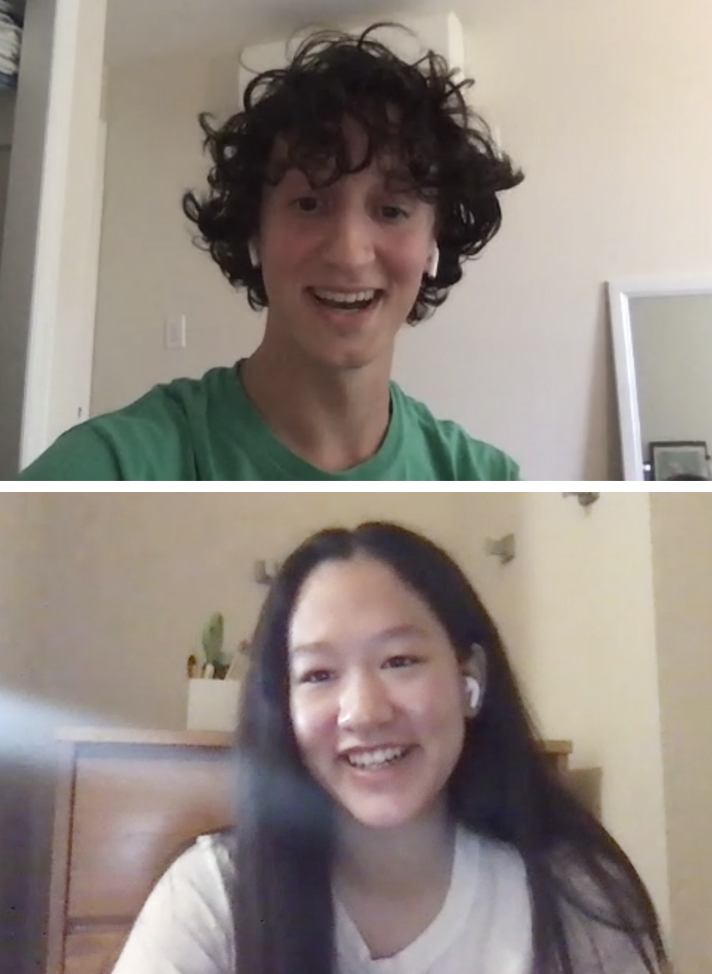
James Kellner of Verona, N.J. attended WesFest with his mother, Michele Kellner, and grandmother, Maria Montoto.

James Kellner of Verona, N.J. attended WesFest with his mother, Michele Kellner, and grandmother, Maria Montoto.

More than 500 admitted students and their families descended on Wesleyan’s campus for WesFest, the annual celebration of all things Wesleyan. Between Wednesday, April 17 and Friday, April 19, they were treated to dozens of tours, panels, lectures and demonstrations to acquaint them with Wesleyan’s academics, student organizations, athletics and facilities.

On Friday around noon, the sun came out and visitors took a break to enjoy a barbecue lunch on Foss Hill while a student band played.

Admitted student Cloie Logan of Albuquerque, N.M. visited Wesleyan with her parents, Nina Logan and Jimmy Miranda.

Admitted student Cloie Logan of Albuquerque, N.M. visited Wesleyan with her parents, Nina Logan and Jimmy Miranda. (Photos by Olivia Drake)

Cloie Logan and her parents came all the way from Albuquerque, N.M. Cloie fell in love with Wesleyan after visiting as a high school junior, and was accepted early decision I.

“Basically since December, I’ve been aching to be here,” she said. At WesFest, she said, “I ate a lot of really delicious food, went to a comedy show, saw Prometheus, went to a few department office hours, and visited the Argus,” where she hopes to work as a student.

James Kellner of Verona, N.J. also was admitted early decision. He visited Wesleyan with his mother and grandmother, and met with the coach of the wrestling team, which he plans to join. He plans to study economics.

“I like it a lot. I like the people, the diversity,” he said. “Just the vibe here—it’s relaxed and easygoing.”

Accompanied by her parents and younger sister, Anne Chen of New York City had heard President Michael Roth speak earlier in the day, and took a tour. Her initial impressions of Wesleyan: “It’s really friendly and open. It’s a really supportive community. People seem really creative.”

Malaysia Johnson of Prince Frederick, M.D. visited with her mother and grandmother. After attending a student-to-student panel, she said, “I was impressed with how active the students at Wesleyan are with volunteering and things like that.”

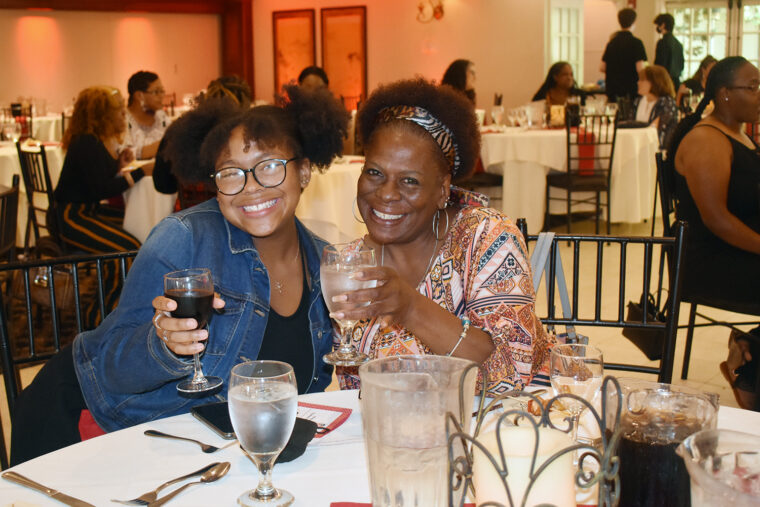
Malaysia Johnson of Prince Frederick, M.D. attended a student-to-student panel and was impressed by how active Wesleyan students are in community service. She is pictured with her mother, Glenda Johnson, and her grandmother, Delois Johnson.

Malaysia Johnson of Prince Frederick, M.D. attended a student-to-student panel and was impressed by how active Wesleyan students are in community service. She is pictured with her mother, Glenda Johnson, and her grandmother, Delois Johnson.

Jackson Dumont of Albany, N.Y. attended a class on astronomy, which he found, “really interesting.”

“I like all the different academic opportunities available to me at Wesleyan,” he said.

Lucy Salwen of Amherst, Mass. visited with her mother. She sat in on an environmental science class, stayed overnight with a current student host, saw a performance by Prometheus—“That was really cool. A little scary.”—and attended a co-ed ultimate Frisbee team practice.

“I’ve been walking around campus and seeing the same faces again. It seems like a nice size,” she said.

VIDEOS and PHOTOS of the event are below. View the complete WesFest photo gallery on the Wesleyan Flickr page(more…)

Wesleyan President Michael S. Roth signed an agreement between Wesleyan and Vermont Law School that guarantees admission for College of the Environment graduates meeting GPA and LSAT thresholds into Vermont's Environmental Law Program. At left, Sonia Mañjon, vice president for institutional partnerships and chief diversity officer, and at right, Barry Chernoff, director of College of the Environment, accompanied President Roth at the signing on April 3.

Wesleyan President Michael S. Roth signed an agreement between Wesleyan and Vermont Law School that guarantees admission for College of the Environment graduates meeting GPA and LSAT thresholds into Vermont’s Environmental Law Program. At left, Sonia Mañjon, vice president for institutional partnerships and chief diversity officer, and at right, Barry Chernoff, director of College of the Environment, accompanied President Roth at the signing on April 3.

Thanks to a new partnership, graduates from Wesleyan’s College of the Environment who meet certain academic standards will be guaranteed admission to Vermont Law School’s prestigious JD (Juris Doctor/Doctor of Law), JD/master’s or master’s degree programs. Vermont’s Environmental Law Program, the largest in the country, is widely considered to be one of the best environmental law programs in the United States.

President Michael S. Roth signed the agreement between Wesleyan and Vermont Law School on Wednesday, April 3.

“We’re excited to provide this option for students in the College of the Environment to take their interdisciplinary exploration of environmental issues to the next level through advanced study of the law, policy and regulation,” said Roth. “The COE was conceived of as a place where scholars can think about translating their research into action in the public sphere. Vermont Law School offers superb programs in environmental law and policy. Earning a JD or master’s degree there certainly will empower our graduates to make an even greater difference in the world.”

“We are delighted to sign this agreement with Wesleyan University and look forward to welcoming qualified graduates from its College of the Environment to the Master’s and the JD degrees offered at Vermont Law School,” said Marc Mihaly, President and Dean of Vermont Law School. “Students from Wesleyan fit the profile of our most successful students – they are smart and committed to making a difference in their communities and, indeed, in the world.”

“In my mind, Vermont Law School is the premier school for environmental law in the country,” remarked Barry Chernoff, director of College of the Environment and Robert Schumann Professor of Environmental Studies. “Pursuing further study in environmental policy, regulation and law will enable our students to influence critical environmental issues facing our country—and the world—over the next century.”

Under the agreement, graduates of Wesleyan’s College of the Environment will be guaranteed admission, with a waiver of all application fees, into Vermont Law School’s JD, Master in Environmental Law and Policy (MELP), or Master in Energy Regulation and Law (MERL) programs. Qualified applicants must complete all requirements to earn a Bachelor’s degree from Wesleyan; complete a minimum of 15 credits for a JD, or 16 credits for a master’s, at Wesleyan; have a cumulative grade point average of 3.2 or higher; earn an LSAT score of 150 or higher for the JD; and present a letter of recommendation from the director of the College of the Environment. The agreement applies to those who have graduated from Wesleyan within four years.

College of the Environment students are especially well-prepared to pursue this type of work after graduation, said Chernoff, because Wesleyan requires them to do their primary scholarship in a particular discipline, and then examine environmental issues from multiple lenses for the Environmental Studies linked major. Majors are also required to complete a capstone project on an environmental topic, principally from the perspective of their primary major, which offers good practice in real world environmental research. The emphasis on critical thinking from an interdisciplinary perspective, which takes into account the viewpoints of all stakeholders, gives “our students a great basis for doing environmental policy work in the future,” Chernoff said.

He added that a significant number of COE graduates currently go on to earn law degrees. Current students he consulted about a partnership with Vermont Law School gave universally positive feedback.

Chernoff said he has, and will continue, to promote the partnership among faculty, students, alumni and prospective students. “I really think it’s important for young people to have interesting opportunities available to them after graduation, and for Wesleyan to provide gateways for students into careers,” he said.

In addition, Chernoff is exploring the development of other partnerships to provide COE students with different avenues for post-graduate education in areas such as public health, environmental management, sustainability and sustainable design.

Richard Grossman, professor of economics.

Professor of Economics Richard Grossman has been named a 2013 Guggenheim Fellow. He will work on a project about the evolution of banking regulation across the industrialized world.

Awarded by the John Simon Guggenheim Memorial Foundation, the fellowship assists research and artistic creation “for men and women who have already demonstrated exceptional capacity for productive scholarship or exceptional creative ability in the arts.” This year, 175 scholars, artists and scientists were selected to receive fellowships from a group of almost 3,000 applicants from the U.S. and Canada.

“The Guggenheim Foundation has been giving awards to distinguished scholars and artists for nearly 90 years, including Nobel laureates, Pulitzer Prize winners, a winners of a host of other important awards. It is an honor to be in such company,” said Grossman. “It is particularly meaningful to be the only member of the 2013 class of Guggenheim Fellows who is an economist.”

Describing his project, Grossman said, “I will be looking in particular at how historical evolution affects current day banking regulation—what those in the business call, ‘path dependence.’ So, for example, if California had particularly liberal banking laws (eg. Easy entry into banking, a minimum of restrictions on how banks can conduct business) in the 19th century, and if Connecticut had particularly stringent laws (eg. High barriers to entry, many restrictions on banking operations), how likely is it that the relative stringency of their laws will remain today?”

He added, “I am excited about this research. When banks work well, they contribute to economic prosperity; when they don’t, things can go very wrong. This research will help identify which regulatory regimes have been conducive to economic growth and stability and which have not. I hope that the results will provide guidance to policy makers in the U.S., Europe, and Japan who are currently crafting new regulations.” (more…)

Artist-in-residence Urip Sri Maeny, who is known on campus as "Maeny," says Javanese dance requires highly controlled movements of different parts of the body to be synchronized with musical rhythms. (Photo by Olivia Drake)

Artist-in-residence Urip Sri Maeny, who is known on campus as “Maeny,” says Javanese dance requires highly controlled movements of different parts of the body to be synchronized with musical rhythms. (Photo by Olivia Drake)

In this issue of The Wesleyan Connection, we ask “5 Questions” of Urip Maeny, artist in residence in dance. She she has taught at Wesleyan since 1972, and will retire this year.

Q: Please tell us when and how you first began studying Javanese dance.

A: I began studying Javanese dance informally when I was still in elementary school in my hometown of Pekalongan in Central Java, Indonesia in the early 1960s. In 1961, I studied at the gamelan conservatory (high school level) in Surakarta. The school allowed me to focus my study on dance—especially Javanese dance, but also Balinese and Sudanese dance. After graduating, I taught dance at the conservatory for a couple of years. As both a student and faculty member at the conservatory, I danced in many cities in Java and Bali. Once, I performed the most sacred Javanese dance in the court of Surakarta.

Then, in 1968, I moved to Jakarta, and worked at the Cultural Office there. My assignment included teaching at the Presidential Palace, especially to the children of the President. I was also a member of a performing arts group, which performed abroad in Hong Kong, Australia and the Middle East.

Q: How did you end up coming to the U.S., and teaching at Wesleyan?

A: In 1971, I joined my husband, Sumarsam, who at that time was working and teaching gamelan at the Indonesian Embassy in Canberra, Australia. In 1972, Wesleyan invited Sumarsam to teach gamelan, so we both departed Australia for Wesleyan. Soon after arriving at Wesleyan, the Wesleyan Music Department assigned me to assist my husband, teaching Javanese dance. I taught Javanese dance as part of the World Music Program until I was transferred to the Dance Department in the mid-1980s. I continue to teach a course in Javanese dance, and closely collaborate with the gamelan group in the Music Department. I direct Javanese dance and dance drama on and off campus, including a Javanese dance drama and gamelan performance at Lincoln Center in New York. While in residence at Wesleyan, I have performed in many cities in the U.S. and abroad. I have also briefly taught Javanese dance at Cornell and at Smith College.

Q: What has kept you at Wesleyan for 40 years?

A: Teaching Javanese dance to American students is a challenge, especially when you teach it by yourself. Javanese dance requires highly controlled movements of different parts of your body to be synchronized with musical rhythms. (See more photos of Maeny ‘s class online here. Watch a video of Maeny teaching Javanese Dance at Wesleyan online here.)  (more…)

Andy Szegedy-Maszak

Andy Szegedy-Maszak

In his role as 2013 Distinguished Teaching Fellow, Andy Szegedy-Maszak, professor of classical studies and the Jane A. Seney Professor of Greek, brought a slice of Wesleyan to members of the Wesleyan community—alumni, parents, admitted students—living in select cities on the West Coast.

The Distinguished Teaching Fellowship—of which Szegedy-Maszak is the first recipient—offers the professor the opportunity to teach a course outside of his/her usual departmental offerings. Szegedy-Maszak is teaching a course through the Allbritton Center for the Study of Public Life on photography and its effect on social movements. It was this topic he explored in his WESeminar on the Road, which took him to San Diego, Los Angeles, San Francisco and Seattle.

His talk included a discussion of Jacob Riis’s photos of tenement dwellers in New York City during the late 1800s, published in the famous book How the Other Half Lives, along with images of Depression-era tenant farmers in Let Us Now Praise Famous Men by writer James Agee and photographer Walker Evans. Additionally, Szegedy-Maszak analyzed one other photograph that helped focus his thoughts on the ability of photography to influence social change. (more…)

Two Wesleyan students received honorable mentions from the Barry M. Goldwater Scholarship and Excellence in Education Foundation.

Sam Factor '14

Sam Factor ’14

Sam Factor ’14, a physics and computer science double major, and Elliot Meyerson ’14, a computer science and mathematics double major, each received a letter of congratulations and a certificate from the foundation. The 2013-14 Goldwater Scholars were selected on the basis of academic merit from a field of 1,107 mathematics, science, and engineering students who were nominated by the faculties of colleges and universities nationwide.

Factor, who hails from Madison, Wisc., hopes to pursue a Ph.D in physics and conduct research in physics, work in industry or teach at the university level. At Wesleyan, Factor works with Fred Ellis, professor of physics, on asymmetric wave transport in nonlinear PT-symmetric electronics.

PT-symmetric systems have unchanged behavior under a combined reversal of time and reflection in space.

“We have shown that the combination of PT-symmetry and nonlinear gain and loss elements produce asymmetric wave transport. This is a remarkable feature and can be used to build devices that exhibit many interesting properties such as unidirectional invisibility and could lead to a device able to transmit and receive signals at the same time on the same frequency.”

During his senior year, Factor may write a senior thesis or complete the BA/MA program.

Elliot Meyerson '14

Elliot Meyerson ’14

Meyerson, of Silver Spring, M.D., hopes to pursue a Ph.D. in computer science and conduct research towards general intelligence and teach at the university level.

Meyerson’s computer science advisor is Eric Aaron, assistant professor of computer sciences, and Wai Kiu Chan, professor of mathematics. He plans on writing a computer science thesis in 2013-14.

The Barry Goldwater Scholarship and Excellence in Education Program was established by Congress in 1986 to honor Senator Barry M. Goldwater, who served his country for 56 years as a soldier and statesman, including 30 years of service in the U.S. Senate. The Goldwater Foundation is a federally endowed agency established by Public Law 99-661 on Nov. 14, 1986.

Since its first award in 1989, the Foundation has bestowed over 6,550 scholarships.

Geoffrey Stone, the Edward H. Levi Distinguished Service Professor at the University of Chicago, delivered the 22nd annual Hugo L. Black Lecture on Freedom of Expression on April 18.

Geoffrey Stone, the Edward H. Levi Distinguished Service Professor at the University of Chicago, delivered the 22nd annual Hugo L. Black Lecture on Freedom of Expression on April 18. (Photo by Bill Tyner ’13)

Geoffrey Stone, the Edward H. Levi Distinguished Service Professor at the University of Chicago, delivered the 22nd annual Hugo L. Black Lecture on Freedom of Expression on April 18.

The topic of this year’s event was “Justice Alito’s First Amendment.”

Stone explored the current state of constitutional jurisprudence, with a particular eye on the approach of the most “conservative” of the current justices. How they undertake the challenge of interpreting the often vague and open-ended guarantees of the Constitution? What explains their decisions in the most controversial cases, involving such issues as the constitutionality of campaign finance regulation, affirmative action, and gun control? He then turned  to Justice Samuel Alito’s approach to interpreting the free speech guarantee of the First Amendment to illustrate more general observations about the conservative justices and to illuminate Justice Alito’s own “vision” of the First Amendment.

Stone was admitted to the New York Bar in 1972 and has been a member of the University of Chicago’s law faculty since 1973. He served as a law clerk to Judge J. Skelly Wright of the U.S. Court of Appeals for the District of Columbia Circuit and to Justice William J. Brennan Jr. of the Supreme Court of the United States.

Professor Stone teaches and writes primarily in the area of constitutional law. His most recent books are Speaking Out! Reflections on Law, Liberty and Justice (2010); Top Secret: When Our Government Keeps Us in the Dark (2007) and War and Liberty: An American Dilemma (2007). He’s currently working on a new book, Sexing the Constitution, which will explore the historical evolution in western culture of the intersection of sex, religion and law.

Among his many public activities, Professor Stone is a member of the Board of Directors of the American Constitution Society, a member of the National Advisory Council of the American Civil Liberties Union, a Fellow of the American Academy of Arts and Sciences, a Fellow of the American Philosophical Society, a member of the American Law Institute and a member of the Straight for Equality Project.

The lecture, endowed by Leonard S. Halpert, Esq., ’44, is named in honor of the late U.S. Supreme Court Justice Hugo Black. The series is designed to bring to the Wesleyan campus distinguished public figures and scholars with experience and expertise in matters related to the First Amendment and freedom of expression. Former Hugo Black Lecture speakers have included U.S. Supreme Court Justice Antonin Scalia, Lawrence Tribe, Jack Balkin, Lawrence Lessig, Justice Harry Blackmun and others.

A commentary on “Professor Stone’s First Amendment Views and Its Jurisprudence,” written by Halpert for this lecture, is online here. (To download Halpert’s essay, open the link and save it to your desktop.)

Share your "This is Why" reason you love and value your Wesleyan experience and education through the new campaign website.

Share your “This is Why” reason you love and value your Wesleyan experience and education through the new campaign website.

At a March 1 Board of Trustees dinner kicking off the public phase of Wesleyan’s campaign, President Michael S. Roth celebrated the substantial success of the effort so far: more than $285 million raised toward the goal of $400 million, with support of financial aid as the top campaign goal.

The funds raised will also go to the endowment to support teaching, research and student engagement.

Roth said the generous early support of the campaign reflected alumni commitment to ensuring access to Wesleyan for generations of students.

A video of Roth’s remarks is available on the new campaign website, http://thisiswhy.wesleyan.edu, a destination for storytelling, campaign news and giving.

Alumni, parents and friends are being asked to consider why Wesleyan is their cause and share their “This Is Why” stories and “Because” photos on the site. The most popular photo posted so far is that by Joss Whedon ’87, which reached nearly 5,000 individuals on Wesleyan Facebook.

#THISISWHY

Watch President Roth speak on the campaign in this video: (more…)

Hyunjin "Chelsey" Cho '13, Sarah Chrystler '13, Amy Cao '15 and Sarah Croucher, assistant professor of anthropology, assistant professor of archaeology, hold artifacts collected from the "Beman Triangle" site near Wesleyan. The pieces will be on exhibit April 4-May 31 in downtown Middletown.

Hyunjin “Chelsey” Cho ’13, Sarah Chrystler ’13, Amy Cao ’15 and Sarah Croucher, assistant professor of anthropology, assistant professor of archaeology, hold artifacts collected from the “Beman Triangle” site near Wesleyan. The pieces will be on exhibit April 4-May 31 in downtown Middletown.

Between Vine Street, Cross Street and Knowles Avenue near Wesleyan, an innocuous looking triangle of land forms the “Leverett Beman Historic District,” listed on the State Register of Historic Places and part of the Connecticut Freedom Trail. This area is the site of one of the earliest planned African American communities in the United States.

Blue glass artifact from the Beman site.

Students discovered this cobalt blue glass shard at the Beman site.

During the spring of 2012, Sarah Croucher, assistant professor of anthropology, assistant professor of archaeology, led an archeological excavation at the “Beman Triangle” site. Several Wesleyan students and community members participated in the dig and unearthed dozens of materials relating to healthcare and everyday practices, such as cooking and dining.

On April 4, Wesleyan will partner with the Middlesex County Historical Society to present an exhibit featuring many artifacts from the excavation. “Unearthing Community: Archaeology of the Beman Triangle” is curated by Croucher and three students: Sarah Chrystler ’13, Amy Cao ’15 and Hyunjin “Chelsey” Cho ’13. Cho is double majoring in art history and economics and has helped curate exhibits at the Davison Art Center and Smithsonian Institution.

“Artifacts from these excavations help to build a picture of daily life in these households during the late 19th century,” Croucher explained. “Materials from one of the houses also has provided a range of artifacts which seem to relate to late-19th century pharmaceutical production, opening up conversations as to the nature of healthcare at this time.”

Multiple houses dotted the Beman Triangle landscape in the 19th century (more…)

Piers Gelly ’13 and Daniel Nass ’13 created a nine-part documentary series on “The Minds of Makers."

Piers Gelly ’13 and Daniel Nass ’13 created a nine-part documentary series on “The Minds of Makers.”

In Kilkenny, Ireland, a man spins wool from freshly shorn sheep into rich fibers. A furniture maker in South Pomfret, Vt. studies the natural geometry of wood he turns into tables, chairs and consoles. And in London, England, a silversmith wielding a hammer transforms smooth metal into beautifully shaped and textured bowls, vases and pieces of art.

These and other craftspeople are featured in a series of nine short documentary films produced and directed by Piers Gelly ’13 and Daniel Nass ’13. Each film in the series, titled, “The Minds of Makers,” shows the creative process of a craftsperson working in a different medium—wood, glass, metal, wool. The films are available to view on ArtBabble, a website created by the Indianapolis Museum of Art to showcase art video content.

Gelly, a College of Letters major, won the Writing Program’s Annie Sonnenblick Writing Award last spring and received a grant to travel around France, Ireland and England researching historical recreation. He planned “to visit places where groups of people attempt to preserve and recreate ‘pure’ craft practices for various reasons of historical authenticity.” The “crown jewel,” he explained, was a 13th century chateau fort in Burgundy called Guédelon, which workers are building from scratch using period technology.

When Gelly was home in Milwaukee that spring break, he met up with Jon Prown of the Chipstone Foundation, a Milwaukee-based foundation that promotes craft and design education and scholarship. The two discussed Gelly’s travel and research plans, and Prown said he’d love to have a series of videos made about the people Gelly would be interviewing. Chipstone offered financial support for the project. Gelly then asked Nass, a friend since freshman orientation and a film studies major, if he’d like to come along and work on the films. The two had previously collaborated on two issues of the 48 Hour Magazine, and on articles for Ampersand, the Argus’ comedy supplement.

Piers Gelly ’13 and Daniel Nass ’13 filmed craftsman Michael Eden in England.

Piers Gelly ’13 and Daniel Nass ’13 filmed Michael Eden in England. Eden unites tradition and modern technology in the intricate ornamental objects that he designs and creates via 3D printing.

Gelly attributes his interest in questions of tradition and history largely to the College of Letters curriculum, and, in particular, to conversations with Javier Castro-Ibaseta, assistant professor of history, assistant professor of letters, and Tula Telfair, professor of art and Gelly’s thesis advisor. In addition, two introductory film classes Gelly took as a freshman “definitely gave me some film knowledge,” he said.

Though Nass is a film major, he said he never had an opportunity to take Wesleyan’s documentary filmmaking course. Instead, he feels that two creative nonfiction writing courses he took—“Distinguished Writers/ New Voices” with Anne Greene, and “Intermediate Nonfiction Workshop” with Lisa Cohen—best prepared him to undertake this project.

“There’s a lot of commonalities [between writing and documentary filmmaking] with the process of gathering materials, conducting interviews and figuring out how to shape what you have into a narrative. The experience I got in those classes helped me a lot when I was thinking about how I want to put these films together,” said Nass.

Gelly and Nass traveled and filmed the documentaries through June and part of July 2012.

The craftspeople featured in the films include subjects from Gelly’s Sonnenblick research, family friends, and people they met through Chipstone.

“All our subjects seemed really pleased to be interviewed. Since most never explain their work to anyone step by step, this was an opportunity for them to share a huge wealth of thoughts and ideas that they normally don’t,” Gelly said. “Some of the most interesting things we discussed were the basics of working with their materials, which these people take for granted but which the rest of us never think to wonder about.”

Piers Gelly ’13 and Daniel Nass ’13 documented how the Cushendale Woolen Mills in Ireland uses turn-of-the-century manufacturing techniques to produce fine wool. The film is one of nine documentaries featured in the "Mind of Makers" series.

The Cushendale Woolen Mills in Ireland uses turn-of-the-century manufacturing techniques to produce fine wool. The film is one of nine documentaries featured in the student-produced “Mind of Makers” series.

Nass added, “For many of the people we interviewed, the work that they do just consists of doing. Often, when we would ask them a question about some specific aspect of their technique, it seemed like they would have to figure out how to articulate it. One thing that came up over and over again was the way that an acquired craft is kind of fundamentally not able to be articulated. You have to learn just by doing. They did their best to explain in words how their practices worked.”

Another common theme that emerged in the interviews, said Nass, was “the relationship between tradition and innovation.” For example, they interviewed a basket maker who was one of the last practitioners of a centuries-old craft. In contrast, another subject, who had begun his work in traditional pottery making, went on to creating intricate ornamental objects using new 3-D printing technology.

“Everybody was in some way informed by the past, and chose to either carry on tradition or create something completely new,” Nass said.

In the fall, Gelly and Nass asked some musically-inclined friends—including Ben Seretan ’10, Ashlin Aronin ’13, Jack Ladd ’15 and Danny Sullivan ’13—to contribute soundtrack music for the films.

The first five films went online at ArtBabble in January, and the last four appeared in late March.

Gelly said he hopes the films cause viewers to “take a second look at the objects around them.”

This coming summer, Gelly and Nass plan to make several more films in the series—focusing on American craftspeople—while they shoot a longer documentary for Chipstone about face jugs. As Nass explained, these stoneware jugs with clay faces on them were made by slaves in South Carolina over a limited period of time in the 19th century. “The project is still in its conceptual planning stages, but if all goes well, we’ll be in South Carolina conducting interviews,” Nass said.

Though neither student has concrete plans for the long term, Nass said, “I really love doing independent documentary work like this. I could definitely see myself continuing with it.”

#THISISWHY


Ellen Alexander '14, Professor Joop Varekamp and graduate student Lauren Camfield in Argentina.

Ellen Alexander ’14, Professor Joop Varekamp and graduate student Lauren Camfield in Argentina.

Ellen Alexander ’14, Professor Joop Varekamp and graduate student Lauren Camfield recently returned from Argentina where they studied the eruptive products of the Copahue volcano March 7-March 19.

Varekamp, the Harold T. Stearns Professor of Earth Science, professor of environmental studies, has studied the volcano since 1997. It erupted in 2000 and again in December 2012.

“Many Wesleyan students have done their senior theses and grad theses on Copahue. It’s exciting stuff for us volcanology types,” Varekamp said.

Camfield sampled the products of the most recent eruption of Copahue, which included ash, pumice and volcanic bombs. She will analyze her samples at Wesleyan for major and trace elements on a X-ray fluorescence machine and analyze any melt inclusions at the American Museum of Natural History in New York on an electron microprobe.

“This information can give us insight on what is happening in the magma chamber of the volcano as well as depth of crystallization of minerals,” Camfield said. (more…)

The Wesleyan Board of Trustees reviews tenure cases three times each year during its meetings on campus, scheduled as the cases arise. At the most recent meeting in March, the Board awarded tenure — effective July 1, 2013 — to these faculty members:

Elijah Huge, associate professor of art, has taught at Wesleyan since 2006.  A licensed architect, his work includes private commissions and award-winning competition entries for the High Line (New York, N.Y.), the Bourne Bridge|Park (Bourne, Mass.), and the Tangshan Earthquake Memorial (Tangshan, China).  His writing and design work have been featured in PraxisThresholdsPerspectaArchitectural RecordLandscape ArchitectureDwellJournal of Architectural Education, and Competitions.  His current scholarly research examines the historical emergence of architectural emergency devices, from the automatic sprinkler to the Vonduprin panic bar. He founded the atelier North Studio as part of the architecture curriculum within the Department of Art and Art History. Through it, students work in collaboration with each other and Huge to develop and produce research-driven and conceptually-driven projects with real-world clients. The work of the studio has been published widely and received awards from the American Institute of Architects, the Connecticut Department of Environmental Protection, and the Association of Collegiate Schools of Architecture. His B.A. and M.Arch. are from Yale University, where he received the AIA Henry Adams Medal and was editor of Perspecta 35: Building Codes.

Barbara Juhasz, associate professor of psychology, associate professor of neuroscience and behavior, came to Wesleyan in 2006. She studies the cognitive processes involved in word recognition during reading. In particular, she is interested in the interpretation of the visual input of written language. She is author or co-author of more than 35 articles and book chapters, eight of which include Wesleyan students as co-authors, as well as more than 40 conference presentations. She holds a B.A. from Binghamton University; her M.S. and Ph.D. are from the University of Massachusetts, Amherst.

Steven Stemler, associate professor of psychology, came to Wesleyan in 2005. (more…)

« Prev - Next »