Feed on
Posts
Comments

Tag Archive 'student research'

Several Wesleyan faculty, graduate students and alumni participated in the 2009 Geological Society of America Annual Meeting Oct. 18-21 in Portland, Ore.

Suzanne O’Connell, associate professor of earth and environmental sciences, director of the Service Learning Center, presented a research poster and delivered a presentation titled “Techniques and Tools for Effective Recruitment, Retention and promotion of Women and Minorities in the Geosciences.” She spoke about the grant-funded organization Geoscience Academics in the Northeast (GAIN), which was established to build a community of academic geoscience women within a small geographic area.

Johan Varekamp, the Harold T. Stearns Professor of Earth Science, professor of earth and environmental sciences, presented an abstract of his research titled “Twelve Years of Element Flux Measurements at Copahue Volcano.” He spoke about measuring water fluxes and river water compositions on the volcano for the last 12 years including a magmatic eruption period in 2000.

Varekamp and Ellen Thomas, research professor of earth and environmental sciences, presented the paper “Natural and Human Impacts on the Evolution of Block Island, RI.” Sarah Gillig ‘09, Emma Kravet ‘09 and Conor Veeneman ‘09 also contributed to the paper.

Dana Royer, assistant professor of earth and environmental sciences, gave a talk titled “Leaf Economic Traits from Fossils Support a Weedy Origin for Angiosperms.” Royer explained how many key aspects of early angiosperms are poorly known. By studying leaf economic traits such as photosynthetic rate and leaf lifespan, Royer concludes that early Cretaceous landscapes were populated with weedy angiosperms with short lived leaves.

Royer’s former post-doc Dan Peppe and Gabriela Doria M.A. ‘09 gave a talk. McNair Fellow Sofia Oliver ‘10 attended and co-authored Peppe’s paper.

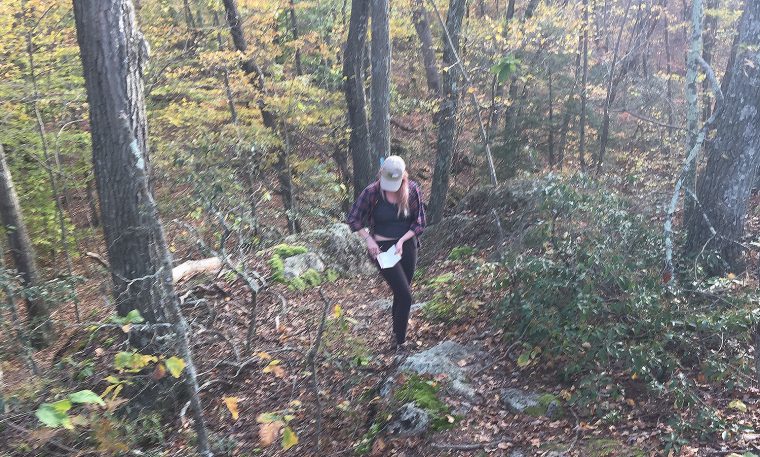
Earth and Environmental Sciences major James Rea ‘09, who currently works at the Cascade Volcano Observatory, presented his work on “Regional Magmatic Setting of Callaqui Volcano (S-Andes, Chile).” Rea samples several rocks from lava flows, scoria cones and dikes around the volcano for trace elements, mineral chemistry and radiogenic isotope compositions.

Earth and Environmental Sciences graduate student Tristan Kading presented a similar abstract titled “Copahue Volcano, Argentina: Introducing ‘Extreme Environments’ on Earth to High School Students” and “Lake Caviahue, Argentina as a Source-Sink for Volcanic Arsenic and Phosphorus.”  Kadding has spoke to local high school students about field work in the small village of Caviahue. The talks highlight the nature of geological field work while touching on some important basic concepts in earth science.

Other attendees included Peter Patton, professor and chair of earth and environmental sciences and Emma Mendelsohn ‘10.

Jacob Mergendoller '11 discovered that Facebook profiles may contain a great deal of alcohol content and are accessible by anyone, regardless of age.

Jacob Mergendoller '11 discovered that Facebook profiles may contain a great deal of alcohol content and are accessible by anyone, regardless of age.

Jacob Mergendoller ’11 is changing the way Facebook markets alcohol on the social networking site.

In a research article titled “Alcohol Promotion on Facebook,” published in The Journal of Global Drug Policy and Practice, Mergendoller and co-authors Sarah Mart and Michele Simon explain how the social networking site Facebook changed its advertising policies and regulations from not offering online advertising to soliciting paid advertisements for products and services including alcohol products.

“There are a number of loopholes in Facebook’s enforcement of their own alcohol advertising policy,” Mergendoller says. “There are some age restrictions on the alcohol content on Facebook (meaning inaccessible to minors), but there is also a strong presence of alcohol advertisements in different forms which can be accessed by anyone.”

For the report, Mergendoller explored the prevalence of alcohol-related content found in popular aspects of Facebook profiles and identified aspects of Facebook that contain a great deal of alcohol content and are accessible by anyone, regardless of age.

Psychology major Mergendoller wrote the article during a summer internship at the Marin Institute, an organization which fights to protect the public (more…)

Earth and environmental sciences graduate student George Bennum ‘08 received an honorable mention for his student research poster titled “3D Modeling of Synsedimentary Faults in the Capitan Reef, Guadalupe Mountains, NM/TX” at the American Association of Petroleum Geologists “Rocky Mountain Rendezvous of Geoscience Students and Employers.” Phil Resor, assistant professor of earth and environmental sciences, is Bennum’s advisor.

Manju Hingorani, associate professor of molecular biology and biochemistry, speaks on DNA mismatch repair during the 10th annual Molecular Biophysics Program Sept. 24 at Wadsworth Mansion in Middletown. More than 70 students and faculty attended the day-long event.

Manju Hingorani, associate professor of molecular biology and biochemistry, speaks on DNA mismatch repair during the 10th annual Molecular Biophysics Program Sept. 24 at Wadsworth Mansion in Middletown. More than 70 students and faculty attended the day-long event.

Wilma Olson, the Mary I. Bunting Professor of Chemistry at Rutgers University, was the keynote speaker. She spoke about DNA Mechanics and Regulation. Olson is an expert on the influence of chemical architecture on the structure and properties of nucleic acids.

Wilma Olson, the Mary I. Bunting Professor of Chemistry at Rutgers University, was the keynote speaker. She spoke about DNA Mechanics and Regulation. Olson is an expert on the influence of chemical architecture on the structure and properties of nucleic acids.

At left, Michael Weir, director of the Hughes Program in the Life Sciences, professor of biology, and in center, Brian Northrop, assistant professor of chemistry, listen to Olson's presentation.

At left, Michael Weir, director of the Hughes Program in the Life Sciences, professor of biology, and in center, Brian Northrop, assistant professor of chemistry, listen to Olson's presentation.

Northrop also delivered a talk during the retreat titled 'Dynamic self-assembly as a route to new organic materials.'

Northrop also delivered a talk during the retreat titled 'Dynamic self-assembly as a route to new organic materials.'

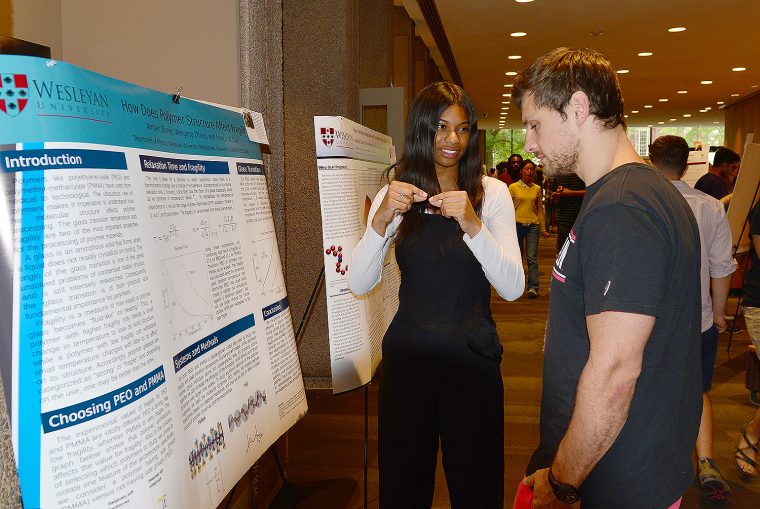
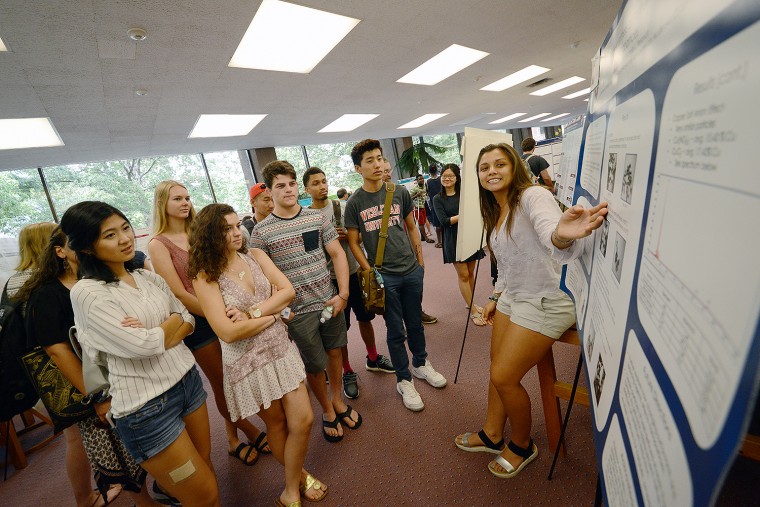
During a poster session, molecular biology and biochemistry graduate student F. Noah Biro explains his DNA mismatch repair research titled "Developing Reporter Systems to Monitor the Structural Dynamics of MutS." Biro's faculty advisor is Manju Hingorani.

During a poster session, molecular biology and biochemistry graduate student F. Noah Biro explains his DNA mismatch repair research titled "Developing Reporter Systems to Monitor the Structural Dynamics of MutS." Biro's faculty advisor is Manju Hingorani.

Laurel Appel, director of the McNair Program, adjunct associate professor of biology, senior research associate, listens to Biro explain his research.

Laurel Appel, director of the McNair Program, adjunct associate professor of biology, senior research associate, listens to Biro explain his research.

Olson mingled with students during the Poster Session.

Olson mingled with students during the Poster Session.

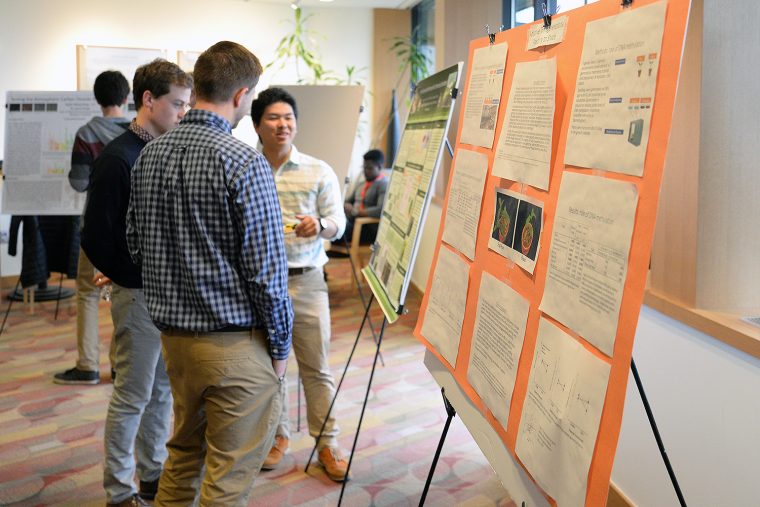
Chemistry graduate student Daniel Czyzyk, center, explains his research titled "Heptosyltransferase I and its Role in Biofilm Formation." Czyzyk's advisor is Erika Taylor, assistant professor of chemistry.

Chemistry graduate student Daniel Czyzyk, center, explains his research titled "Heptosyltransferase I and its Role in Biofilm Formation." Czyzyk's advisor is Erika Taylor, assistant professor of chemistry.

David Beveridge, the University Professor of the Sciences and Mathematics, professor of chemistry, reads through the program schedule.

David Beveridge, the University Professor of the Sciences and Mathematics, professor of chemistry, reads through the program schedule.

Chemistry graduate student Sattanathan Paramasivan talks about his research titled "A mix and measure fluorescence screening assay for the exploration of selective quadruplex binders." Paramasivan's advisor is Philip Bolton, professor of chemistry.

Chemistry graduate student Sattanathan Paramasivan talks about his research titled "A mix and measure fluorescence screening assay for the exploration of selective quadruplex binders." Paramasivan's advisor is Philip Bolton, professor of chemistry.

Rich Olson, assistant professor of molecular biology and biochemistry, speaks on "Poring over the structural basis of Vibro cholerae cytolysin assembly."

Rich Olson, assistant professor of molecular biology and biochemistry, speaks on "Poring over the structural basis of Vibro cholerae cytolysin assembly."

Chemistry Department research assistant Elizabeth Wheatley, right, speaks to Olga Buzovetsky '10, about her research titled "A Molecular Dynamics Study of DNA Bending in the Integration Host Factor-DNA Complex." The complex of the protein IHF with oligometric DNA results in a highly-unusual structure in which the DNA is bent by nearly 180 degrees. Wheatley's advisor is David Beveridge.

Chemistry Department research assistant Elizabeth Wheatley, right, speaks to Olga Buzovetsky '10, about her research titled "A Molecular Dynamics Study of DNA Bending in the Integration Host Factor-DNA Complex." The complex of the protein IHF with oligometric DNA results in a highly-unusual structure in which the DNA is bent by nearly 180 degrees. Wheatley's advisor is David Beveridge.

Molecular biology and biochemistry graduate student Yan Li explains her research titled "Investigation of the Binding Interaction of S. cerevisiae MutS homologs MSH2-MSH6 and MSH4-MSH5 with Holliday Junctions." Yan's advisors are Ishita Mukerji, chair and professor of molecular biology and biochemistry, and Manju Hingorani. (Photos by Olivia Bartlett Drake and Manju Hingorani)

Molecular biology and biochemistry graduate student Yan Li explains her research titled "Investigation of the Binding Interaction of S. cerevisiae MutS homologs MSH2-MSH6 and MSH4-MSH5 with Holliday Junctions." Yan's advisors are Ishita Mukerji, chair and professor of molecular biology and biochemistry, and Manju Hingorani. (Photos by Olivia Bartlett Drake and Manju Hingorani)

Jeff Katzin '10 received a Certificate in Art Museum Studies after completing the Summer Institute in Art Museum Studies (SIAMS) at Smith College in Northampton, Mass.

Jeff Katzin '10 received a Certificate in Art Museum Studies after completing the Summer Institute in Art Museum Studies (SIAMS) at Smith College in Northampton, Mass.

For six weeks, Jeff Katzin ’10 studied with museum curators and art faculty, took behind-the-scenes tours of museums and helped execute an exhibition.

Katzin was one of 15 students who participated in the Summer Institute in Art Museum Studies (SIAMS) at Smith College from June 15 to July 24. He received a Certificate in Art Museum Studies upon completion of the highly-selective program.

“At SIAMS, I met with current professionals, I learned about issues and debates regarding museums and their collections from the program’s directors and visiting speakers, and I visited many museums and saw a lot of great art,” Katzin says.

Supported by the Andrew W. Mellon Foundation, the Samuel H. Kress Foundation, and numerous individual donors, SIAMS is a six-week intensive program that introduces college students and recent graduates to various aspects of art museums, (more…)

CaVar Reid '11, a Mellon Mays Undergraduate Fellow, presents his research proposal July 30 in Fisk Hall. Reid's project is titled "Ain't No Fathers in the Hood: An Ethnography of Incarcerated Black Fatherhood."

CaVar Reid '11, a Mellon Mays Undergraduate Fellow, presents his research proposal July 30 in Fisk Hall. Reid's project is titled "Ain't No Fathers in the Hood: An Ethnography of Incarcerated Black Fatherhood."

According to the Bureau of Justice Statistics, one out of every three black men between the ages 20 and 29 is in prison, on probation or on parole. Of these men, 94 percent are fathers.

English and African American Studies major CaVar Reid ‘11 is curious to discover how prison affects a man’s ability to be a father.

“I want to ask them, ‘What were your expectations about your relationships with your children when you were incarcerated? How do you think your incarceration has affected your children? How did you stay involved with your children?’” Reid says.

As a 2009-11 Mellon Mays Undergraduate Fellow, Reid will have the opportunity to interview incarcerated and former prisoners at the Osborne Association for an independent research project titled “Ain’t No Fathers in the Hood: An Ethnography of Incarcerated Black Fatherhood.” His study will include the interviews, and cite historians, social workers and anthropologists on prison fatherhood.

“With my data I am trying to tell the story of a group of black men who, I would suggest, (more…)