Feed on
Posts
Comments
Cecilia Miller, associate professor of history, co-chair and tutor in the College of Social Studies; Richard Adelstein, professor of economics and tutor in the College of Social Studies; and Brian Fay, the William Griffin Professor of Philosophy, tutor in the College of Social Studies and editor of History and Theory, gather at the College of Social Studies 50th Anniversary lecture Nov. 6.

Cecilia Miller, associate professor of history, co-chair and tutor in the College of Social Studies; Richard Adelstein, professor of economics and tutor in the College of Social Studies; and Brian Fay, the William Griffin Professor of Philosophy, tutor in the College of Social Studies and editor of History and Theory, gather at the College of Social Studies 50th Anniversary lecture Nov. 6.

From its beginnings in 1959, Wesleyan’s College of Social Studies (CSS) has grown into a well-respected program and is celebrating its 50th year in 2009. The multidisciplinary program allows students to explore the subjects of government, history, economics and philosophy concurrently. Many attended lectures and celebrations for CSS during Homecoming/Family Weekend last weekend.

The first event of the weekend was a CSS Public Lecture by John Goldberg (CSS 1983, professor of Law, Harvard Law School) on Friday, Nov.  6. His talk was titled “John Locke on Tort Reform (Really!): A CSS Parable.”  John Goldberg was introduced by Brian Fay, the William Griffin professor of philosophy. Richard Adelstein, professor of economics, gave the response.

Peter Kilby, professor of economics, emeritus, chaired a CSS Alum Speaker Panel on CSS Entrepreneurs on Saturday, Nov. 7. The panelists included Steve Torok ‘73, Donald Zilkha ‘73, Lincoln Frank ‘79, and Jonathan Bush ‘93. A second Alum Speaker Panel, on International Affairs, was chaired by Andrew Crawford ‘97, and included panelists Bob Hunter ‘62, John Stremlau ‘66, Carl Robichaud ‘99 and Michael Brotchner ‘95.

“What impressed me the most was the way in which speaker after speaker mentioned, with specific examples, how the method of study in the CSS continued to profoundly shape the way they handled their jobs in their subsequent career, whether it be a public defender or a venture capitalist,” said Peter Rutland, Colin and Nancy Campbell Professor in Global Issues and Democratic Thought and CSS Co-Chair, who attended the event.

“Skills such as being able to write quickly and clearly; and to see many sides of a problem, and integrate them in a single analysis served CSS students well after graduation,” he recounts.

Along with Fay, Adelstein, Kilby (who retired last year), and Rutland, core professors in the CSS within the past 20 years include Cecilia Miller, associate professor of history and CSS Co-Chair; Bill Barber, Andrews Professor of Economics, Emeritus; the late David Titus, professor of government, Emeritus; David Morgan, professor of history, Emeritus; Don Moon, Ezra and Cecile Zilkha Professor in the College of Social Studies and professor of government; Nancy Schwartz, professor of government; Giulio Gallarotti, professor of government; Gil Skillman, chair and professor of economics; Joyce Jacobsen, Andrews Professor of Economics; and Erik Grimmer-Solem, associate professor of history and director of the Public Affairs Center.

According to the program description, the College of Social Studies “was created in the belief that the various social studies can best be pursed together, rather than in isolation, and that the student will better understand the subject matter and the nature of each discipline by considering it in its relation to the other disciplines, and to develop a sense of methodological criticism supported by work in philosophy.”

Former Wesleyan President Victor Butterfield crafted the plan for the CSS along with the College of Letters (also celebrating 50 years) and the College of Quantitative Studies, which disbanded in the 1960’s. Butterfield believed strongly in the importance of interdisciplinary studies.

“The curriculum stresses fundamental techniques of analysis in economics, history, and government, as well as their application in the subject matter of those fields. Precision in writing and speaking is stressed in essays and class work. A number of lectures and seminars provide a sense of community that balances the educational aspect of the College,” the program description states.

Throughout the years, CSS has produced more than 930 graduates including John Driscoll, who currently works as the University Relations Alumni Director. Driscoll graduated from Wesleyan in class of 1962 and was a member of the very first CSS class.

“In the beginning the CSS was the unstructured part of Wesleyan,” Driscoll says. “The ‘normal’ parts of Wesleyan were filled with requirements, grades, and regular tests. That may seem odd today, but then we were looked on with a mixture of curiosity, envy and resentment because while others were sweating through the regular grind, we weren’t. At least not in the same way. We were “free” of the superficial preoccupation with grades; we could focus on learning for its own sake. And for us the ability to focus on one tutorial for ten weeks along with a colloquium on epistemology each week was true liberation.”

CSS graduates have gone on to excel in a range of fields, including government service, law, business, the arts and even medicine. CSS graduates have also been well represented on the Wesleyan Board of Trustees, and in recent years the Board has included four or more CSS alumni.

Wesleyan’s Long Lane Farm Club and the Environmental Studies Program hosted the sixth annual Pumpkin Festival Oct. 31 at the farm on Long Lane. The event was open to the Wesleyan and local community. Activities included food, baked goods, live music, Farmer’s Market vendors, pumpkin sales and painting, face painting, t-shirt designing and tours of the organic farm.

Music was provided by the student band, 350 degrees, and faculty band, the Mattabessett Pickers. (Photos by Valerie Marinelli)

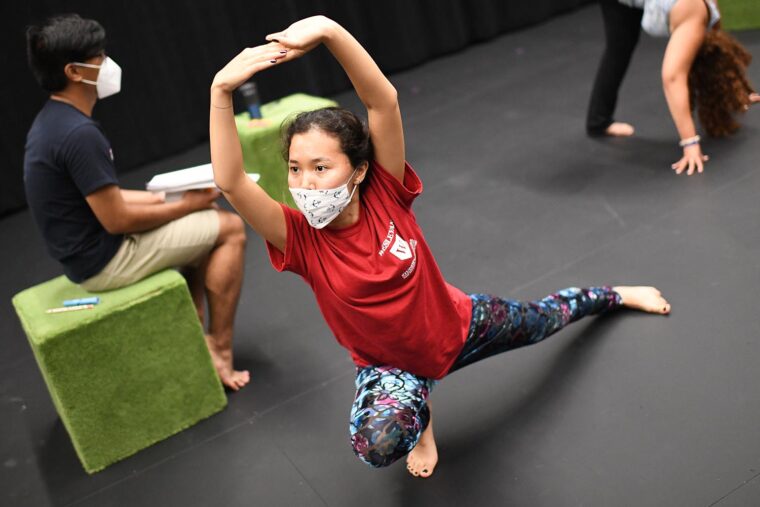
"Student Bodies," an exhibit organized by the Center for Creative Research Student Task Force Group, interrogates how students are present on campus, both during their four years at Wesleyan and after they graduate. The student dancers portray a physical body and the body of work students produce while writing and reading for classes.  The case inside the Usdan University Center is filled with old academic papers to explore the tension between each student's material body and the one they create through academic work. While moving, the students are thinking about how the physical body is included or left out of texts or readings, and how their physical bodies relate to the bodies that are written in texts.

"Student Bodies," an exhibit organized by the Center for Creative Research Student Task Force Group, interrogates how students are present on campus, both during their four years at Wesleyan and after they graduate. The student dancers portray a physical body and the body of work students produce while writing and reading for classes. The case inside the Usdan University Center is filled with old academic papers to explore the tension between each student's material body and the one they create through academic work. While moving, the students are thinking about how the physical body is included or left out of texts or readings, and how their physical bodies relate to the bodies that are written in texts. Pictured is Asa Horvitz '10.

The Center for Creative Research is a nationwide initiative that puts movement based artists in long-term residency situations on college campuses to explore how movement and scholarship can inform one another. The project was spearheaded by CCR intern Mark McCloughan '10; Eiko Otake, a CCR fellow and visiting artist; and Liz Lerman, head of the Liz Lerman Dance Exchange.

The Center for Creative Research is a nationwide initiative that puts movement based artists in long-term residency situations on college campuses to explore how movement and scholarship can inform one another. The project was spearheaded by CCR intern Mark McCloughan '10 (pictured); Eiko Otake, a CCR fellow and visiting artist; and Liz Lerman, head of the Liz Lerman Dance Exchange.

(Photos by Cora Lautze ‘11)

John Meerts, vice president for finance and administration, thanks members of the Wesleyan Student Assembly for bringing the new Zipcar to campus. Zipcar is the world’s largest car-sharing service and provides students with a convenient, economical and environmentally-friendly alternative to having a car on campus.

John Meerts, vice president for finance and administration, thanks members of the Wesleyan Student Assembly for bringing the new Zipcar to campus. Zipcar is the world’s largest car-sharing service and provides students with a convenient, economical and environmentally-friendly alternative to having a car on campus.

WSA president Mike Pernick '10 speaks at the Zipcar launch. Zipcar allows students to use the vehicle for errands, entertainment, or road trips–without the cost and hassle of owning a car. All reservations include fuel, insurance, and roadside assistance.

WSA president Mike Pernick '10 speaks at the Zipcar launch. Zipcar allows students to use the vehicle for errands, entertainment, or road trips–without the cost and hassle of owning a car. All reservations include fuel, insurance, and roadside assistance.

Charlie Kurose '10 checks out one of the two Zipcars that will be used by Wesleyan students. To sign up for Zipcar use, students over the age of 18 need a valid driver's license and a credit card.

Charlie Kurose '10 checks out one of the two Zipcars that will be used by Wesleyan students. To sign up for Zipcar use, students over the age of 18 need a valid driver's license and a credit card.

For more information on Zipcar, visit http://www.zipcar.com/wesleyan. (Photos by Lauren Valentino ‘10)

ABC News Correspondent William Blakemore '65 spoke to the Wesleyan community Nov. 3 in the Memorial Chapel. His talk was titled "The Many Psychologies of Global Warming."

ABC News Correspondent William Blakemore '65 spoke to the Wesleyan community Nov. 3 in the Memorial Chapel. His talk was titled "The Many Psychologies of Global Warming."

Blakemore began focusing on the topic of global warming five years ago for ABC News. He gave examples displaying different psychologies, as well as manmade global warming’s place in history.

Blakemore began focusing on the topic of global warming five years ago for ABC News. He gave examples displaying different psychologies, as well as manmade global warming’s place in history.

Karl Scheibe, director of the Susan B. and William K. Wasch Center for Retired Faculty, visiting faculty in psychology, speaks at the Blakemore event. The event was  sponsored by the Wasch Center for Retired Faculty, Department of Psychology, and the Robert Schumann Lecture Series in the Environmental Studies Program.

Karl Scheibe, director of the Susan B. and William K. Wasch Center for Retired Faculty, visiting faculty in psychology, also spoke at the Blakemore event. The event was sponsored by the Wasch Center for Retired Faculty, Department of Psychology, and the Robert Schumann Lecture Series in the Environmental Studies Program.

The event was attended by several Wesleyan faculty, staff and students, and members of the local community. (Photos by Stefan Weinberger '10)

The event was attended by several Wesleyan faculty, staff and students, and members of the local community. (Photos by Stefan Weinberger '10)

As part of the Writing at Wesleyan Russell House Series, poet Bernadette Mayer spoke and read prose Oct. 14. Mayer is the author of more than two dozen volumes of poetry, including Midwinter Day, Sonnets, The Desires of Mothers to Please Others in Letters, and Poetry State Forest. A former director of the Poetry Project at St. Mark's Church in the Bowery and co-editor of the conceptual magazine 0 to 9, Mayer has been a key figure on the New York poetry scene for decades.

As part of the Distinguished Writers Series at Wesleyan, poet Bernadette Mayer spoke and read prose Oct. 14. Mayer is the author of more than two dozen volumes of poetry, including Midwinter Day, Sonnets, The Desires of Mothers to Please Others in Letters, and Poetry State Forest. A former director of the Poetry Project at St. Mark's Church in the Bowery and co-editor of the conceptual magazine 0 to 9, Mayer has been a key figure on the New York poetry scene for decades.

Mayer's visit was organized by Elizabeth Willis, the Shapiro-Silverberg Associate Professor of Creative Writing, associate professor of English.

Mayer's visit was organized by Elizabeth Willis, the Shapiro-Silverberg Associate Professor of Creative Writing, associate professor of English.

Fiction writer John Brandon spoke on Oct. 21. Brandon is the author of the novel Arkansas and the forthcoming novel The Semester. He is currently the Grisham Writer-in-Residence at University of Mississippi.

Fiction writer John Brandon spoke on Oct. 21. Brandon is the author of the novel Arkansas and the forthcoming novel The Semester. He is currently the Grisham Writer-in-Residence at University of Mississippi.

Brandon's visit was organized by Deb Olin Unferth, assistant professor of English. (Photos by Jeffrey Katzin '10)

Brandon's visit was organized by Deb Olin Unferth, assistant professor of English. (Photos by Jeffrey Katzin '10)

For more information on the Distinguished Writers Series go to: http://www.wesleyan.edu/writing/distinguished_writers/

Aaron Peisner '12 and Garth Taylor '12 pose in a photo during the opening reception for Mike Disfarmer: Photographs in the Zilkha Gallery Oct. 9. Hailing from the small mountain town of Heber Springs, Arkansas, the photographer known as Mike Disfarmer captured the lives and emotions of rural Arkansans in starkly intimate portraits.

Aaron Peisner '12 and Garth Taylor '12 pose in a photo during the opening reception for Mike Disfarmer: Photographs in the Zilkha Gallery Oct. 9. Hailing from the small mountain town of Heber Springs, Arkansas, the photographer known as Mike Disfarmer captured the lives and emotions of rural Arkansans in starkly intimate portraits.

Aaron Peisner '12 and Garth Taylor '12 pose as rural Arkansans living between 1939 and 1945 in this portrait.

Aaron Peisner '12 and Garth Taylor '12 pose as rural Arkansans living between 1939 and 1945 in this portrait.

Cordelia Blanchard '12, Lindsay Keys '11, and Daria Lombroso '11 mimic Disfarmer's portraits by reflecting the mood at the height of the Great Depression. Disfarmer's photographs show the dramatic shifts during the war years, as well as the transformations of postwar prosperity.

Cordelia Blanchard '12, Lindsay Keys '11, and Daria Lombroso '11 mimic Disfarmer's portraits by reflecting the mood at the height of the Great Depression. Disfarmer's photographs show the dramatic shifts during the war years, as well as the transformations of postwar prosperity.

Mary Lauran Hall '10 and Mark McCloughan '10 pose for their picture. All photos were e-mailed to students after the event. Accompanying photos taken by Disfarmer are included in the exhibit. The photographs in this exhibition were printed from the original glass plates, recovered in the 1970s from Disfarmer's studio.

Mary Lauran Hall '10 and Mark McCloughan '10 pose for their picture. All photos were e-mailed to students after the event. Accompanying photos taken by Disfarmer are included in the exhibit. The photographs in this exhibition were printed from the original glass plates, recovered in the 1970s from Disfarmer's studio.

Fisherman Andrew is the son of Trish Thompson, lab manager in the Biology Department. He was one of more than 50 children enrolled in Wesleyan’s preschool who walked in the annual Halloween Parade Oct. 30 on Wesleyan’s campus. The children stopped on the steps of North College and sang songs while the parent paparazzi took photos and videos.

Fisherman Andrew is the son of Trish Thompson, lab manager in the Biology Department. He was one of more than 50 children enrolled in Wesleyan’s preschool who walked in the annual Halloween Parade Oct. 30 on Wesleyan’s campus. The children stopped on the steps of North College and sang songs while the parent paparazzi took photos and videos.

Chocolate cupcake Tiana, 3, is the daughter of Amy MacQueen, assistant professor of molecular biology and biochemistry.

Chocolate cupcake Tiana, 3, is the daughter of Amy MacQueen, assistant professor of molecular biology and biochemistry.

Lobster Sam Higgins, 1 1/2, is the son of Sally Ross and Scott Higgins, associate professor of film studies.

Lobster Sam Higgins, 1 1/2, is the son of Sally Ross and Scott Higgins, associate professor of film studies.

Pirate Samuel Sorkin is son of Carolyn Sorkin, director of the Office of International Studies.

Pirate Samuel Sorkin is son of Carolyn Sorkin, director of the Office of International Studies.

Flower Geneva Wiliarty, 20 months, is the daughter of Kevin Wiliarty, academic computing manager for the Social Sciences, and Sarah Wiliarty, assistant professor of government, and tutor in the College of Social Studies.

Flower Geneva Wiliarty, 20 months, is the daughter of Kevin Wiliarty, academic computing manager for the Social Sciences, and Sarah Wiliarty, assistant professor of government, and tutor in the College of Social Studies.

Froggy Alan is the son of Yun Liu, coordinator of the Scientific Computing and Informatics Center.

Froggy Alan is the son of Yun Liu, coordinator of the Scientific Computing and Informatics Center.

Ladybug Aria and fireman Orr walk behind their father, Rabbi David Leipziger Teva, director of Religious and Spiritual Life and University Jewish Chaplain. At right, Catherine Crimmins Lechowicz walks in the parade with her twin boys Charlie (walking) and JP.

Ladybug Aria and fireman Orr walk behind their father, Rabbi David Leipziger Teva, director of Religious and Spiritual Life and University Jewish Chaplain. At right, Catherine Crimmins Lechowicz walks in the parade with her twin boys Charlie (walking) and JP. (Photos by Olivia Bartlett Drake)

Book translated by Krishna Winston.

Book translated by Krishna Winston.

Krishna Winston, the Marcus L. Taft Professor of German Language and Literature, dean of the Arts and Humanities and coordinator of the Mellon Mays Undergraduate Fellowship, translated the new book, Don Juan: His Own Version, written by Peter Handke.

The 128-paged book is published by Farrar, Straus & Giroux.  It will be released in Feburary.

This photograpy book was published by Wesleyan University Press in October 2009.

This photograpy book was published by Wesleyan University Press in October 2009.

Wesleyan University Press published a photographic book about the Connecticut River Oct. 23. The photographs in The Connecticut River: A Photographic Journey Through the Heart of New England follow this major waterway for 410 miles, from its origin near the Canadian border to its wide mouth on Long Island Sound, giving readers a vivid portrait of a living artery of the New England landscape. Middletown is featured in the book.

Author and photographer Al Braden opens the book with an essay introducing important aspects of the river, and Chelsea Reiff Gwyther, executive director of the Connecticut River Watershed Council, closes with an essay that succinctly highlights the environmental pressures that the river faces.

The book has 136 full-page color photos, ranging from close-ups to dramatic aerials, to reveal the river as few people are privileged to experience it. Readers will see and learn about many facets of the river, including its landscape, history, development, conservation, geologic formations, flora and fauna, and, of course, the moods of the water, sky, and riverbank. Informative captions provide a wealth of information about the images, which depict every¬thing from pristine misted mornings to rich valley farmlands and modern hydroelectric turbines. The Wesleyan University Press book is $35 and available online.

« Newer Posts - Older Posts »