Feed on
Posts
Comments

Tag Archive 'Biology'

When parasites attack woolly bear caterpillars, such as this <em> Grammia incorrupta</em>, the insects eat leaves loaded with chemicals called alkaloids, which seems to cure the infection. The discovery, by Michael Singer, represents the first clear demonstration of self-medication among bugs.

When parasites attack woolly bear caterpillars, such as this Grammia incorrupta, the insects eat leaves loaded with chemicals called alkaloids, which seems to cure the infection. The discovery, by Michael Singer, represents the first clear demonstration of self-medication among bugs.

Michael Singer, assistant professor of biology, is the author of “Self-Medication as Adaptive Plasticity: Increased Ingestion of Plant Toxins by Parasitized Caterpillars,” published in PLoS ONE, March 2009. PLoS ONE is an open access, online scientific journal from the Public Library of Science.

This new article rigorously demonstrates that caterpillars can self-medicate, following up on a previous publication in Nature in 2005. This is the first experimental demonstration of self-medication by an invertebrate animal.

This paper also represents the first publication to arise from research funded by a National Science Foundation (NSF) grant awarded to Singer in December 2007. Kevi Mace BA ’07 MA ’08 assisted with the research.

The research also was featured in an article titled “Woolly Bear, Heal Thyself,” published in Discover Magazine online, and in an article titled “Woolly Bear Caterpillars Self-Medicate — A Bug First,” published in National Geographic News.  The caterpillars also were mentioned in the March 26, 2009 edition of nature-research-highlights-09.

Laura Grabel.

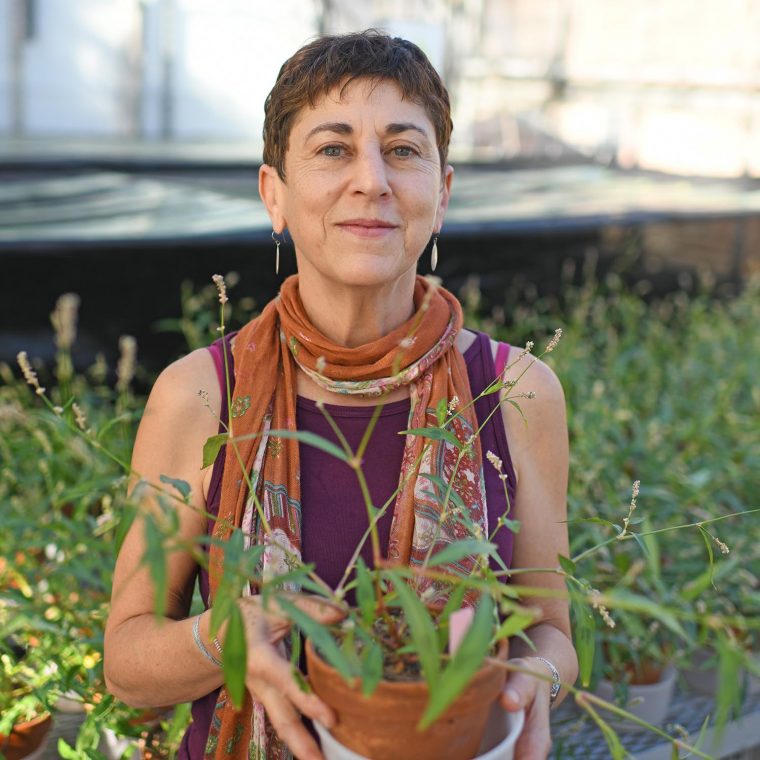
Laura Grabel, the Lauren B. Dachs Professor of Science and Society, is the co-director of the University of Connecticut Human Embryonic Stem Cell Core Facility. (Photo by Alexandra Portis '09)

Sitting in front of the Senate panel, Laura Grabel was ready for the “when” and “why” questions. But she knew one of these questions held a lot more potential danger to her future than the other.

Grabel, the Lauren B. Dachs Professor of Science and Society, professor of biology, is a renowned stem cell researcher. She is also the co-director of the University of Connecticut Human Embryonic Stem Cell Core Facility, part of a $100 million human stem cell research initiative created by the State of Connecticut in 2006.

The stem cell initiative was the state’s response to a veto issued by then-President George W. Bush that restricted federally-funded research on human embryonic stem cell lines to cell lines derived before August 2001. The initiative included a collaboration of three state academic institutions with outstanding stem cell researchers: Yale University, The University of Connecticut and Wesleyan University. During the start-up round, Grabel was not only named co-director of the facility, she received an $878,348 grant for her research.

All of this led up to her sitting in front of the panel at the State Senate in Hartford in the last week of February. (more…)

Gloster Aaron, assistant professor of biology, assistant professor of neuroscience and behavior, is the co-author of “Statistical Significance of Precisely Repeated Intracellular Synaptic Patterns,” published in PLoS ONE 3(12): e3983, Dec. 19, 2008.

Gloster Aaron, assistant professor of biology, assistant professor of neuroscience and behavior, received a $50,000 grant from The Epilepsy Foundation on Dec. 6 titled “STEP Regulation of Epileptogensis in the Hippocampus.”

Drugs prescribed to combat epilepsy can yield unwanted side effects. One reason that drugs have side effects is that they can affect almost every neuron in the brain, regardless of their roles in spreading seizures. Aaron will research ways target only the neurons that may be most important in stopping the spread of seizures. Previous work has shown that a certain protein, STEP, is found in select groups of neurons. One of those groups of neurons, the hilar interneurons of the hippocampus, is a crticial group with regards to epilepsy. By manipulating that protein, researchers can target that group of neurons, and hopefully gain traction in a selective therapy for preventing and curing epilepsy.

Michael Weir, director of the Hughes Program in the Life Sciences, professor of biology, discusses “A Puzzle in Translation Initiation" during the ninth annual Molecular Biophysics Retreat, held at Wadsworth Mansion in Middletown on Sept. 18.

Michael Weir, director of the Hughes Program in the Life Sciences, professor of biology, discusses “A Puzzle in Translation Initiation" during the ninth annual Molecular Biophysics Retreat, held at Wadsworth Mansion in Middletown on Sept. 18.

(more…)

« Prev